
The Rotor premiered in 1955 in Germany, built by Anton Schwarzkopf and operated by its inventor Ernst W. Hoffmeister of Hamburg. Many were built in quick succession around Europe, North America and Australia by different local companies under license.
In USA, although initially collaborating, makers and operators of Rotors became embroiled in a patent disagreement which appears to have been resolved by assigning the rights to build portable Rotors to the Velare Brothers (under the Hoffmeister patent) and the rights to stationary models to the Anglo Rotor Corporation (under the Myers patent). The Velare’s began touring two Rotors around 1954, while Anglo Rotor placed about five rides in parks as concessions. In 1956, stationary Rotors were located at Kennywood, Coney Island (Ohio), Long Beach, Riverview, and Rockaway’s Playland. To view more information on amusement ride and rollercoaster history, visit Victor Canfield’s well researched Amusement Ride Patents.
In the early 1970’s, Chance went on to manufacture a portable version of the Rotor still found in many US parks; made largely obsolete on the travelling circuit by Wisdom’s modern-day equivalent Gravitron
Like Gravitron, Rotor uses basic centrifugal force to pin its occupants to the outsides of the wooden cylinder. Once the optimum speed is reached and the riders are safely stuck to the wall, the operator (observing from above) lowers the floor, leaving riders high up the wall. As the cylinder gradually slows to a stop, riders slowly slide down the wall eventually landing on the lowered floor.


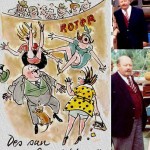
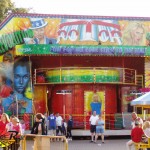
Eugh! lol puke ride!!! Again, we have a lot of travelling models in the UK, can hurt a bit if youre in an awkward position as the drum begins to spin…
Danny - July 22nd, 2009 at 5:33 am
I worked at Cedar Point during the summers in the mid 70’s After the park would close, we would get on the rotor and then try to turn 360 degrees while spinning I usually ended up on my head by the time the ride ended, but actually managed it once in 1976
steve - August 5th, 2009 at 12:59 pm
Looking to buy a rotor for a park in bangalore india, childrens ,smaller and not portable needed- please advise trade leads, india manufacturers
J Michael - September 7th, 2009 at 9:48 pm
rode it couple years ago…. ouch, the floor drop too early, though still stuck to the wall we stayed in our place.
Ride enthuist - October 21st, 2009 at 4:41 am
I want to develop similer rides but which does not retract bottom. It is a taper bottom. After rotation starts if People tries to go to center & hold the piller, they fall on wall.
Can I get some thing from you
S D JOSHI - June 25th, 2010 at 9:27 pm
Dear J Michael,
Let us try tumbler nearby rotor which I am trying to develop
S D JOSHI - June 26th, 2010 at 1:40 am
the floor drops its like the grav’
wavymouth - September 10th, 2010 at 7:15 am
The Gravatron looks much safer.
Unknown - October 2nd, 2010 at 3:50 am
LOOKS SO COOL :) CLICK HER FOR A BETTER PIC OF THE INSIDE!!http://www.westland.net/venicehistory/mapsdocs/images/pop-rotor.jpg
Angel - December 21st, 2010 at 6:54 am
the rotor is a cool ride that smins you round so fast that you stick to the wall and when the floor drops ypu feel like your are flying
tom - January 22nd, 2011 at 10:16 am
I remember the Rotor at Hershey Park. I was a little kid but that memory has always stuck with me. Great ride.
John - April 6th, 2011 at 10:58 pm
i rode a ride like this at riverside park in mass before it was six flags new england that ride is awesome
harry - June 6th, 2011 at 12:33 pm
One original Rotor is still in use on the german carnival circuit and one of the most popular rides werever it is errected.
VulcanNonibird - June 23rd, 2011 at 5:54 am
Still 17 Rotors travelling in Great Britain with the latest manufactured by ARM (UK) in April 2010.
Mike Willis - July 30th, 2011 at 7:49 am
I remember riding one of these as the “Barrel of Fun” at Astroworld, and every time I went it was a “do not miss” for me.
Joe M. - July 30th, 2011 at 8:09 pm
there was one at six flags over texas i went on as a kid in the early 80 it was a blast i wish there were more of them and that parks would keep them and not get rid of them
stephen t. mills - September 25th, 2011 at 4:18 pm
Centripetal, not centrifugal force.
Ed - February 19th, 2012 at 11:18 am
A company in the US called Dartron Industries has resurrected this type of ride, naming it the Rave. On the new version, you board the ride with the floor at ground level. At the start of the ride, the floor is raised, then the spinning starts. The surface of the wall is a giant subwoofer so the music that is played is also felt on your back. When the ride slows down, the floor is raised back up so you can slide back down to it, then the floor lowers again. It is an awesome ride, if a bit short.
John Moore - October 20th, 2012 at 11:32 pm
The first two times last year it was very fun and I didn’t feel nausea but yesterday I went on it the drum was smaller. It made me feel nausea and hurt my throat that time and it felt faster also I got a slight headache
Antony A - April 5th, 2013 at 6:36 am
My favorite ride at Riverview, but I will never understand how they screwed it up when they built it at Great America and called it the Cajun Cliffhanger. My dad was a mechanic at Riverview and I never remember hearing anything about anyone getting hurt at Riverview, but there were fourteen incidents on the Cajun Cliffhanger, and at least seven involved serious injuries. The last one was on July 19, 2000, when a 12-year-old girl suffered crushed toes after the floor of the ride was raised improperly prior to the ride coming to a complete stop. A second rider also had a foot trapped that day. The ride was permanently shut down after that as part of an out-of-court settlement.
Jayne Kranc - July 20th, 2013 at 1:28 pm
Dartron has brought the Rotor back. It is now called the Rave and appears at a lot of the US’s major fairs. I have ridden it and it is a great ride.
John Moore - January 19th, 2014 at 8:35 am
Frontier City brought back their original rotor this season after sitting out for a few years. They changed the name to Tumbleweed. It was previously known as the Terrible Twister. This ride also has a observation deck for the family members who want to wait because they cannot stomach the ride or have little ones in tow.
Kevin Motto - June 9th, 2014 at 2:05 pm
I love the Rotor. It is my favourite ride of all time. The first time l went on the was at Luna Park Sydney. This was this year because l am only 12 and l went to Luna Park with School. It was amazing!!!!!!!!!!!
Courtney Collins - October 14th, 2014 at 3:31 pm
We would like to purchase one such set to install in India. 09420281847 please contact immediately.
Kazi Feroz Salauddin. - June 8th, 2015 at 1:51 am
Six Flags Magic Mountain in California had one called the ‘Spin Out.’ In its last few years of operation it only operated sporadically because of a combination of park staff short-handedness, and people getting injured or sick. For this reason I didn’t get to ride it very often when I went to the park.It was finally removed in 2008. I wish they could have kept it, as it was my favorite flat ride there. I think Magic Mountain needs to dedicate a season to adding a few flat rides or other family friendly rides and take a break from building new coasters so that non-coaster riders and the less adventurous have some more options here. Don’t get me wrong, I’m a coaster freak, but I’d love to see that park become a little more rounded again.
Mike Ford - February 1st, 2016 at 3:11 pm
As a school kid on our yearly field trip this was my favorite ride at Kennywood Park. Had to ride it every chance I could get. After graduating high school I moved to the deep south. I returned many years later with my children hoping they could ride but unfortunately it was gone. I was, and still am so sad.
Danny L - October 26th, 2017 at 3:07 am
My dad was a mechanic at Riverview and he insisted the rotor at Riverview was not the same one at Great America. He said the Riverview one was a Velare and the Great America one was made by Chance. Since Riverview closed in ’67 and Great America opened in ’76 I believed him. It made sense that they were not the same.
Jayne1955 - May 30th, 2018 at 12:15 am
Looks fun until the puke starts throwing
Lois - March 7th, 2023 at 9:30 am
I stayed with my Uncle Fred at 9 Manor Terrace in 1961. We we in transit from Halifax, Canada to Soest Germany (military posting) and happily got delayed in F’stowe for 6 months. I didn’t attend school for that 6 months :) but spend many, many coins at Mannings Amusement Park playing the ‘One Armed Bandits’ and spinning in the ROTOR there. I had never seen anything like the ROTOR and was totally fascinated (I was 13). Great memories!!! I was somewhat adopted by the ‘carnies’ who worked there and spoke a totally incomprehensible trade lingo. I had a fabulous 6 month school vacation there-sure beat ‘readin,writin, & rithmatic’
Michael Minick - July 4th, 2026 at 6:19 am